Blog
Gender and its role in weather information management and dissemination
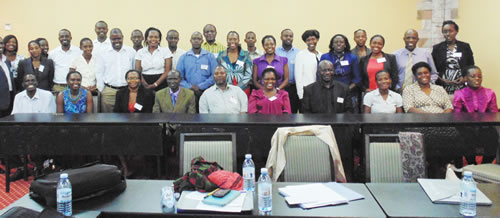
 On June 24, 2015, the NORADWIMEA- ICT project held a workshop on Gender at Royal Suites Hotel in Kamala. Gender is a key aspect of the project; both in the participating institutions and at national level. The purpose of the workshop was to increase the understanding of gender-related issues as they relate with weather management and climate change as well as to promote gender awareness among key stakeholders. The workshop was attended by participants from several institutions, schools, professionals and the media. Some of the facilitators included: Assoc. Prof. C. Obura, Principal, College of Computing and Information Sciences, Makerere University, Dr. Julianne Sansa-Otim, Makerere University (in the context of the project), Dr. Agnes Rwashana Semwanga, Makerere University (in the context of the gender component).
Dean, School of Women and Gender Studies, Makerere University (Introduction to Gender Concepts). Mrs. Annet Kabarungi, Senior Gender Officer, Ministry of Gender, Labor and Social Development (Gender issues in Meteorology and Climate Change – as a Case Study), Mrs. Brenda Kifuko Malinga, UN Women Consultant, Ministry of Gender, Labor and Social Development (How to Promote Gender Awareness Among Stakeholder) and Mr. Fredrick Immanuel Kindi, School of Women and Gender Studies, Makerere University among others. Through this workshop, it was discovered that the WIMEA-ICT project needs to have firm strategies on gender sensitization because resource mobilization in rural areas gives preference to men as opposed to women. Weather information should put the plight of marginalized groups such as women into consideration. The question therefore is; are there strategies in place to bring marginalized groups on board? Without putting gender into proper perspective, the WIMEA-ICT project’s objective will be ‘lost’. Associate Prof. C. Obura opened the workshop and was grateful that women incetivised through this project. However he wondered whether there were any strategies for men in case they found themselves in a vulnerable situation concerning weather or agricultural related issues.
What is gender?
Gender is not the study of women emancipation. It is the study of seeking a balanced relationship between male and female. However, in a bid to empower women so as to get equal opportunities with men, the men have become threatened and in some instances hostile. Therefore, gender experts and activists need to still draw strategies to empower men as well in order to maintain and sustain a levelled gender ground. The WIMEA-ICT project therefore has to have budgetary considerations at planning level to ensure that men are also engendered. The project must put into account the gender issues for both men and women in relation to the available resources. WIMEA can attain gender balance by having equal opportunities for both women and men in allocation of available resources and opportunities. For example the 1.5 point entry privilege given to the girl-child as they join higher education in Uganda has promoted the education balance between men and women in Uganda. This can be maintained until such a time when women and men are advantaged similarly in society.
Gender issues and climate change
While talking about weather and climate change in Uganda, it is important to note that most of the women who are actively involved in agriculture in rural Uganda are illiterate. Is it possible for the illiterate woman to get the meteorologist information as compared to the literate? During this workshop, it was pointed out that it is indeed possible through proper empowerment of women with the right tools and resources.
The existing weather information, especially seasonal forecasts, is not sensitive to gender because it doesn’t consider the unique roles played by men and women. Some women, especially in rural settings, do not plant trees as a source of income. A survey was conducted under the School of Women and Gender Studies, Makerere University, and one of the findings was that women do not plant trees on their marital land because they are not sure if they will last in marriage long enough to harvest the benefits.
Apart from the men and women, it is also important to get children involved in these weather information dissemination processes because climatic information is for all. Information should be packaged in a way that it is well and clearly understood by minors such as children for collective involvement.
Promoting gender awareness among stakeholders – Agriculture (land use), Environment, Fisheries)
Through community dialogue, women can now articulate their issues in some areas. Youth groups have also come up with community solutions. In Some communities, Female Genital Mutilation (FGM) is medically done in order to preserve culture and also to provide health services at the same time. Uganda has made strides but more can be done.
What more can be done in the meteorology field?
The number of meteorologist in Makerere University and Uganda at large is still low and it is even lower for women. This shows a need for more capacity-building at partner institutions and on different levels of training. Information sharing and advocacy among stakeholders should be emphasised. There is another challenge: there is no specific information on how weather information can be accessed. The Uganda National Meteorology Association (UNMA) has a challenge to ensure more people, especially in the rural settings, have access to weather information. Hopefully WIMEA-ICT can assist in this area by developing and packaging information for communities in time. Structures need to be put in place from the top to the grass root level. UNMA also needs to establish partnerships of collaborations towards community developments. In Uganda, meteorology training appears to be silently taken on, and is only taken seriously once a tragedy occurs. There is minimal disaster preparedness in any given situation. Unfortunately most organisations and institutions do not consider weather information to be important to their activities / sectors. Gender desegregated data is also minimal. We need to have statistics to identify the gaps with strategic evidence. During the course of this project, some PhD students should be sent out to various organisations for industrial training. This will help organizations to appreciate and understand the use of weather information for the betterment of the country and disaster preparedness among other benefits. There is World Meteorology Organization (under the United Nations Organisation) in charge of meteorology and hydrology whose syllabus is from Geneva. This should be utilized. ICT is a wonderful tool but there is need to have a concrete way on how it can improve weather information communication in meteorology because weather information decays very fast. It was recommended that UNMA work with WIMEA-ICT researchers to upload any climate updates in a timely manner.
Who makes land use decisions?
Sensitization of both men and women on the benefits of growing improved crop varieties such as improved maize is paramount. Who benefits in cases where land is rented? It is usually the men. Key informants should ensure that women are included in decision making. There is need to know the seasonal characteristics to ensure both men and women have key information. This can be done through churches, mosques and other places of worship as well as through SACCOS. Information should be translated to the community on seed quality in relation to weather and climate of a given area. Does the community know when to plant what? Post-harvest handling, storage and marketing are necessary with a bias towards women since they do most of this work at village level and are most disadvantaged in terms of information access. Seeds selection before rain should be carefully communicated to the farmers, clearly showing how it will improve the quality of their produce. In addition, seeds should be affordable and they should be able to be planted again for sustainability purposes. Uganda needs to generally develop systems that enable effective sharing of ICT information; systems that promote gender awareness to these different groups of people in our society. To this end, presenters and participants were encouraged to emphasise training and awareness: Meteorologists should be more pro-active as practitioners through community/school awareness campaigns. New proposals should be written to deal with how to transform ideas shared in the workshop into actual results.